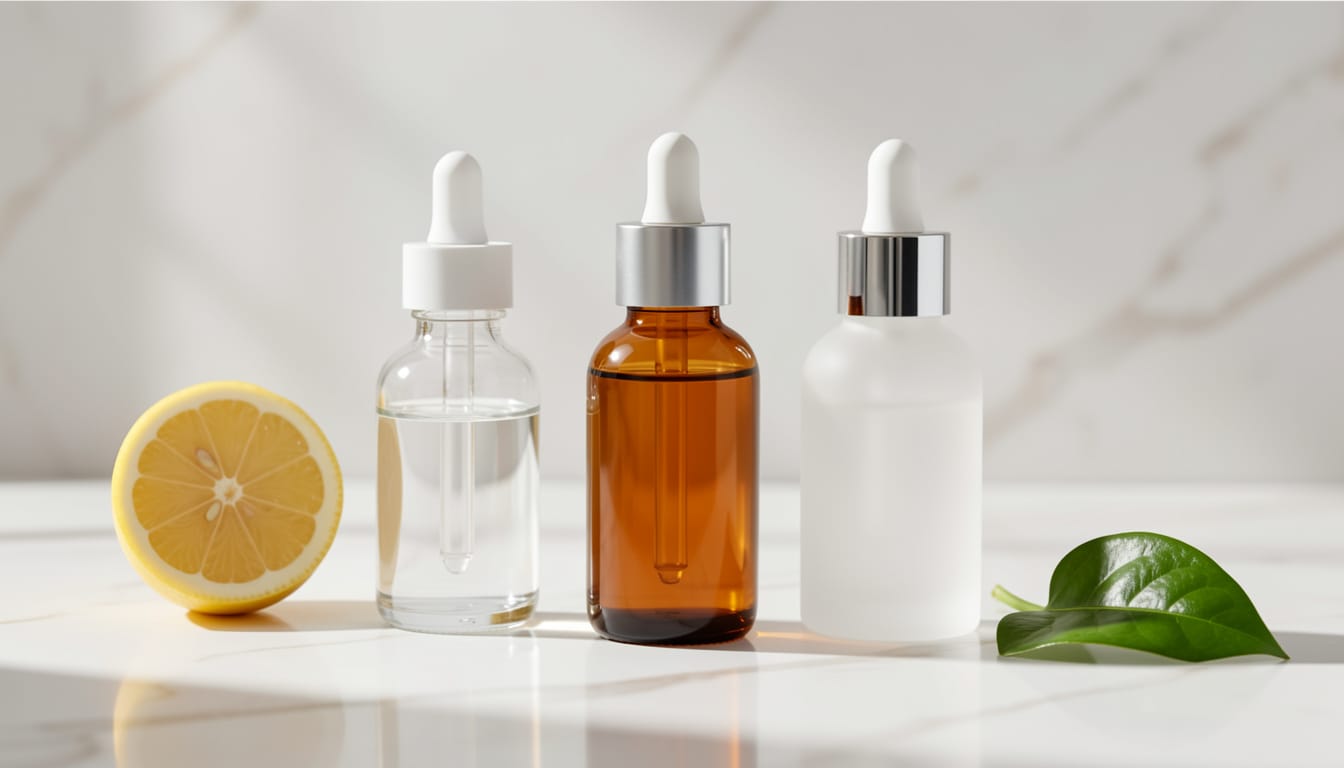
Best vitamin C serums on Amazon 2026 — ranked by stability and concentration
Vitamin C is the most evidence-backed topical antioxidant in skincare. It is also the most frequently formulated incorrectly. This review ranks the top options on Amazon by the chemistry that determines whether a product actually works.
Vitamin C has more peer-reviewed evidence supporting its use in topical skincare than almost any other ingredient. It is also the ingredient most frequently rendered ineffective by poor formulation. Understanding the difference between a vitamin C serum that works and one that merely looks convincing is a chemistry question more than a skincare question — and the answer determines whether you're spending $15 or $180 on something meaningful.
This review ranks Amazon-available vitamin C serums by the variables that determine efficacy: the form of vitamin C used, the concentration, the pH, and the packaging. Where clinical data exists it is cited. Where a product's formulation undermines its own claims, that is noted plainly.
The chemistry you need to understand first
Vitamin C exists in multiple forms in skincare, and they are not equivalent. The differences in stability, skin penetration, and mechanism of action are significant enough that the form of vitamin C in a product matters more than the brand name or the price.
L-ascorbic acid — the gold standard
L-ascorbic acid (LAA) is the bioactive form — the molecule that directly stimulates collagen synthesis, inhibits melanin production, and neutralises free radicals in skin tissue. It is the form used in the majority of clinical studies demonstrating vitamin C's efficacy.
The problem with LAA is instability. It oxidises rapidly on exposure to air, light, and heat, converting first to dehydroascorbic acid and then to diketogulonic acid — an orange-brown compound with no therapeutic activity. A vitamin C serum that has turned dark amber has undergone significant oxidation and is delivering reduced efficacy.
Stabilising LAA requires three conditions: a pH below 3.5, a concentration of 10–20%, and airtight packaging that minimises oxygen exposure between uses. Below 10% concentration, the evidence for collagen stimulation weakens. Above 20%, benefit does not increase proportionally and irritation risk rises significantly.
The low pH required for LAA stability creates a tolerability challenge. At pH 3.0–3.5, LAA serums can cause stinging, redness, and irritation — particularly for sensitive or compromised skin. This is not a formulation error; it is the chemical requirement for the active form to be stable and to penetrate the skin barrier effectively.
Vitamin C derivatives — the stability trade-off
Several stable vitamin C derivatives are used in skincare formulations to address LAA's instability. They do not require a low pH and are generally better tolerated. The trade-off is that they must be converted to LAA in the skin to exert biological activity — and the conversion efficiency varies.
Ascorbyl glucoside (AA2G) — water-soluble, stable at neutral pH, converted to LAA by skin enzymes. Well-studied. The conversion is slower than direct LAA application, but the clinical evidence for brightening and antioxidant activity at concentrations of 2% and above is solid. Better tolerated than LAA by most skin types.
Sodium ascorbyl phosphate (SAP) — stable, converted to LAA by phosphatase enzymes in skin. Demonstrated efficacy for acne reduction in addition to the standard antioxidant and brightening effects — the anti-inflammatory pathway appears distinct from LAA. Well-suited to oily and acne-prone skin.
Ascorbyl tetraisopalmitate — oil-soluble derivative, stable, penetrates the lipid barrier efficiently. Clinical evidence is thinner than LAA or AA2G but shows antioxidant activity. Better suited to dry skin types given the lipid base.
Magnesium ascorbyl phosphate (MAP) — gentler option, good stability, evidence for brightening and some collagen activity, lower irritation potential than LAA. Suitable for sensitive skin.
What to ignore
"Vitamin C complex" without specifying the form is meaningless. Ascorbic acid listed far down the ingredient list after several humectants and emollients is present at a concentration too low to be active. Products in clear glass or pump bottles without airtight seals will oxidise quickly regardless of the starting concentration.
Concentration guide
| Concentration | Use case |
|---|---|
| Below 5% | Antioxidant maintenance, sensitive skin, derivative forms |
| 10–15% | Standard anti-aging and brightening protocol — the evidence sweet spot |
| 15–20% | Maximum efficacy range; higher irritation risk, not proportionally more effective |
| Above 20% | No additional benefit; increased irritation; some evidence of pro-oxidant effects |
Top picks
Best overall: SkinCeuticals C E Ferulic
The most clinically studied vitamin C serum available. The formulation — 15% L-ascorbic acid, 1% alpha-tocopherol (vitamin E), 0.5% ferulic acid, pH 2.5–3.0 — is protected by patent and has been validated in multiple peer-reviewed studies including a landmark Pinnell et al. publication in Dermatologic Surgery. The ferulic acid component stabilises the ascorbic acid and vitamin E combination while providing independent antioxidant activity, extending the formula's efficacy window on skin.
At $166–$182 it is the most expensive product in this review. The evidence base for this specific combination is stronger than for any other vitamin C serum on the market. Whether that evidence justifies the price premium over well-formulated alternatives at a lower price is a reasonable question — but it is the benchmark against which other LAA serums should be compared.
SkinCeuticals C E Ferulic
$166–$182
15% L-ascorbic acid + 1% vitamin E + 0.5% ferulic acid at pH 2.5–3.0. The most clinically validated vitamin C serum formulation available. Airtight pump packaging. Published in peer-reviewed dermatology literature. The gold standard reference point for this category.
- ✓Peer-reviewed clinical validation for this specific formulation
- ✓Ferulic acid extends LAA stability and adds independent antioxidant activity
- ✓Airtight pump packaging minimises oxidation between uses
- ✓15% LAA concentration — centre of the evidence-backed range
Tolerability note: at pH 2.5–3.0, this serum stings on first application for most users. This is expected and diminishes within two to three weeks as skin adapts. Apply to fully dry skin — wet skin increases penetration rate and therefore irritation. If stinging persists beyond four weeks or causes visible redness, the LAA concentration is too high for your skin barrier and a derivative formulation is the better option.
Best mid-range: TruSkin Vitamin C Serum
A well-formulated mid-range option combining 20% vitamin C (as sodium ascorbyl phosphate), hyaluronic acid, and botanical antioxidant support. Sodium ascorbyl phosphate at 20% delivers meaningful antioxidant and brightening activity at a pH that most skin types tolerate comfortably — typically pH 5.5–6.5.
The trade-off versus LAA: SAP's conversion to the bioactive form is enzyme-dependent and less direct than LAA. The brightening evidence is solid; the collagen synthesis evidence is less robust than for high-concentration LAA formulations.
TruSkin Vitamin C Serum
$19–$25
20% sodium ascorbyl phosphate + hyaluronic acid + botanical antioxidants. Stable derivative form tolerated by most skin types including sensitive. Good evidence for brightening and antioxidant activity. Fragrance-free. Pump packaging.
- ✓Sodium ascorbyl phosphate — stable derivative well-tolerated by sensitive skin
- ✓20% concentration — in the active range for the derivative form
- ✓Fragrance-free — no added sensitisation risk
- ✓Significantly lower price than LAA formulations with good tolerability
Best budget: Mad Hippie Vitamin C Serum
Uses ascorbyl glucoside (AA2G) at a disclosed concentration alongside vitamin E, ferulic acid, and hyaluronic acid. The AA2G form is stable, well-tolerated, and has clinical evidence for brightening at concentrations of 2% and above. The addition of ferulic acid follows the same stabilisation logic as the SkinCeuticals formulation, applied here to a derivative rather than LAA.
At under $25, this is the most thoughtfully formulated budget option in the category. The limitation is that AA2G's conversion to bioactive LAA is slower than direct application, meaning the collagen and antioxidant effects accumulate more gradually.
Mad Hippie Vitamin C Serum
$18–$24
Ascorbyl glucoside (AA2G) + vitamin E + ferulic acid + hyaluronic acid. Stable derivative form with solid brightening evidence. Well-formulated at the budget tier — the ferulic acid addition shows formulation awareness that most budget vitamin C products lack.
- ✓Ascorbyl glucoside — stable derivative with clinical brightening evidence
- ✓Ferulic acid included — unusual at this price point, improves stability
- ✓Gentle enough for daily use on most skin types
- ✓Good transparency on ingredient rationale
How to use vitamin C correctly
Timing: vitamin C is best applied in the morning. Its primary mechanism as a topical antioxidant is most useful when the skin is about to be exposed to UV and environmental oxidative stress. It does not cause photosensitivity — unlike retinoids — but it works synergistically with SPF, with the combination providing significantly greater photoprotection than either alone.
Layering order: apply vitamin C to clean, dry skin before other serums. If using niacinamide, apply vitamin C first and wait two to three minutes — the concern about niacinamide converting LAA to niacin is overstated at in-use concentrations, but sequential rather than simultaneous application is the conservative approach.
Retinoid compatibility: vitamin C and retinoids are often described as incompatible. The practical concern is pH conflict — LAA at pH 3.0 and retinoids at pH 5.5–6.0 can neutralise each other's efficacy if applied simultaneously. The solution is not to avoid using both but to use vitamin C in the morning and retinoids in the evening, which is the standard protocol and eliminates any interaction.
Oxidation check: fresh LAA serums should be clear to very pale yellow. Light amber indicates early oxidation — reduced potency but not harmful. Dark amber or orange indicates significant oxidation — the active ingredient has largely degraded. Buy smaller volumes if you are not using the product daily. Refrigerating after opening extends shelf life.
The honest summary
The evidence for vitamin C in skincare is genuinely strong. The key decisions are whether to use LAA or a derivative, and at what concentration.
For most people with tolerant skin and an established skincare routine: LAA at 10–15% in a properly packaged formulation is the most direct path to the clinical outcomes in the literature. SkinCeuticals C E Ferulic is the reference standard — if budget is a constraint, a well-formulated LAA alternative at 10–15% with airtight packaging achieves similar outcomes.
For sensitive skin, beginners, or anyone whose skin doesn't tolerate the low pH of LAA: ascorbyl glucoside or sodium ascorbyl phosphate at 2% or above provides meaningful antioxidant and brightening activity with a tolerability profile that makes consistent daily use achievable. Consistency matters more than potency if a product causes enough irritation to be skipped.
The form and formulation tell you what a vitamin C product is capable of. The packaging tells you whether it will still be capable of it when it reaches your skin.