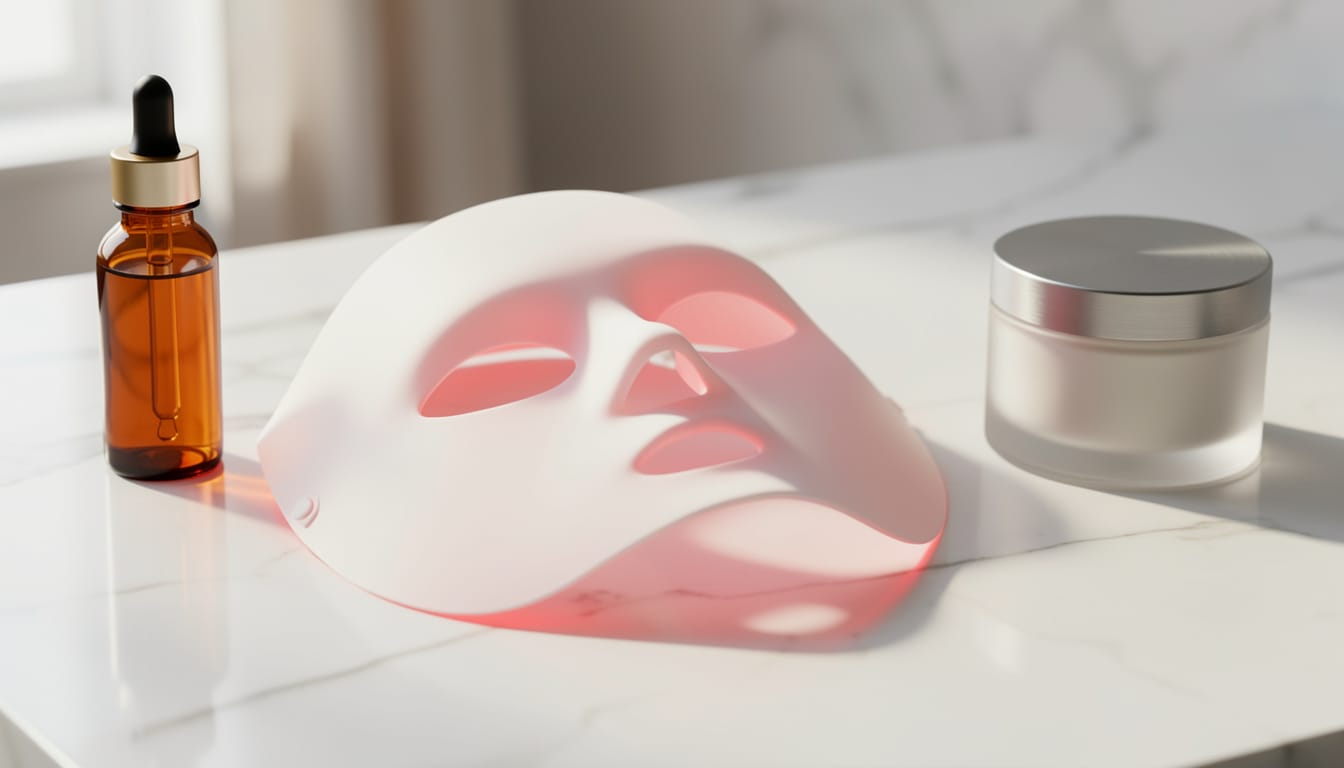
LED face masks for skincare: how to choose one that actually works
LED therapy is a legitimate skincare tool when the device delivers enough light at the right wavelengths. Most masks on the market don't publish the number that tells you whether they do. Here's how to read the specs — and which masks pass.
LED face masks occupy an awkward position in skincare. The underlying science — photobiomodulation, the stimulation of cellular processes through specific light wavelengths — is well-established in peer-reviewed literature. The devices sold to consumers under that science vary enormously in whether they actually deliver a sufficient dose of light to trigger those processes.
The result is a category where the marketing is largely identical across a $50 mask and a $400 mask, and the specification that would tell you which one works — irradiance, measured in milliwatts per square centimetre at the skin surface — is published by a fraction of brands.
This article explains how LED therapy fits into a skincare routine, what specifications to look for, and which masks currently on the market publish the data needed to evaluate them. If a device doesn't publish irradiance, it doesn't appear in our recommendations. That filter eliminates most of the market. What remains is a short, defensible list.
Where LED therapy fits in a skincare routine
LED therapy is an adjunct, not a replacement. It does not deliver actives, it does not exfoliate, and it does not substitute for a sunscreen. What it does — when dosed correctly — is stimulate the cellular machinery that underpins the outcomes topical actives are also trying to achieve.
Specifically, red light in the 630–660nm range activates cytochrome c oxidase in mitochondria, increasing ATP production and cellular energy. This upregulates fibroblast activity, which in turn increases collagen and elastin synthesis. The mechanism is distinct from retinoids (which increase collagen by normalising keratinocyte turnover and inhibiting matrix metalloproteinases) and from peptides (which signal fibroblasts directly through receptor binding). All three are working toward similar structural outcomes through different pathways — which is why combining them is rational rather than redundant.
Near-infrared light at 830–850nm penetrates deeper than red light, reaching the lower dermis and subcutaneous tissue. In a facial skincare context, this adds depth to what the red light is doing at the surface — treating the full dermal thickness rather than just the upper layers.
In practice, the routine integration looks like this: cleanse, tone if relevant, then LED therapy on bare skin before applying any serums or moisturisers. The transient increase in skin permeability and circulation following a session improves absorption of what goes on immediately after. Retinoids and AHAs should go on after LED, not before — photosensitising actives and light sources should be separated.
The one number that tells you if a mask works
Irradiance — mW/cm² at the skin surface — determines how much light energy your skin is actually receiving. From this number you can calculate the dose delivered per session:
Dose (J/cm²) = Irradiance (mW/cm²) × Session time (seconds) ÷ 1000
The therapeutic window for collagen stimulation and anti-aging outcomes is approximately 5–9 J/cm² per session. Below 1 J/cm², the stimulus is insufficient to drive structural change. Above 20 J/cm², diminishing returns and potential tissue stress apply.
A mask running 10 minutes (600 seconds) at 30 mW/cm² delivers 18 J/cm² — within the broader effective range. The same mask at 5 mW/cm² delivers 3 J/cm² — sub-therapeutic. Without the irradiance figure, you cannot do this calculation, and you cannot know whether a device is delivering a meaningful dose or an expensive light show.
This is why irradiance transparency is our non-negotiable filter. A brand that does not publish this number is either unaware of its importance (a quality signal in itself) or aware and choosing not to disclose it (a worse signal).
Wavelengths: what matters for skincare outcomes
630–660nm red light is the primary wavelength for surface collagen stimulation, fine line reduction, and inflammation modulation. This is the most studied range for facial skincare in the peer-reviewed literature.
830–850nm near-infrared penetrates deeper and acts synergistically with red light. Masks that include both wavelengths consistently outperform single-wavelength red-only devices in collagen outcome studies.
415nm blue light targets acne-causing bacteria and is clinically validated for acne reduction. Relevant if acne is part of your concern, less so for pure anti-aging focus.
The difference between 630nm and 660nm, or between 830nm and 850nm, is clinically insignificant — both pairs fall within the same therapeutic windows. Marketing that presents these minor variations as meaningful differentiation is noise.
What the market looks like through an irradiance filter
The LED face mask market in 2026 is large and noisy. When irradiance transparency is applied as a hard filter, the shortlist becomes short very quickly.
Dr. Dennis Gross DRx SpectraLite FaceWare Pro — the most recognised name in this category and the one most frequently recommended by dermatologists. Strong wavelength specification: 605nm amber, 630nm red, 660nm deep red, and 880nm NIR. Does not publish irradiance. Independent estimates place it at 15–25 mW/cm², which at 3 minutes delivers approximately 2.7–4.5 J/cm² — below the optimal therapeutic window for collagen outcomes. A device with this wavelength range at higher irradiance would be an easy recommendation. Without the published number, it cannot be verified.
Solawave Wrinkle Retreat — 660nm red only, no NIR. Single-wavelength devices are outperformed by dual-wavelength in collagen studies. Does not pass on wavelength specification alone.
Project E Beauty LightAura range — irradiance stated for the product collection, not the specific device. Not sufficient for dose calculation.
Omnilux Contour — publishes irradiance on its brand website but not on Amazon. Clinically studied, well-regarded. If you are purchasing direct from Omnilux, this is a credible option. Not included here because this review focuses on Amazon-purchasable devices with listing-level transparency.
Two devices pass cleanly.
Top picks
Best overall: HigherDOSE Red Light Face Mask
The HigherDOSE is the only mid-tier mask that publishes per-wavelength irradiance directly on its Amazon listing: 630nm at 26 mW/cm² and 830nm NIR at 24 mW/cm², for a total of 50 mW/cm². At that irradiance, a 10-minute session delivers 30 J/cm² — above the optimal 5–9 J/cm² window, which means the therapeutic dose is actually achieved in approximately 2–3 minutes. The 10-minute session is conservative rather than minimal.
HigherDOSE Red Light Face Mask
$295–$349
630nm red at 26 mW/cm² + 830nm NIR at 24 mW/cm². Total irradiance 50 mW/cm² published on the Amazon listing. 66 dual-core LEDs (132 diodes). USB-C rechargeable, cordless during sessions, tethered option available. 10 and 20-minute modes. Flexible silicone. FDA cleared. 1-year warranty.
- ✓Per-wavelength irradiance published on the Amazon listing — the only mid-tier mask to do this
- ✓50 mW/cm² total irradiance — therapeutic dose reached in under 3 minutes
- ✓Cordless during sessions — genuinely hands-free for 10 minutes
- ✓Red + NIR dual wavelength — both surface and deeper dermal tissue addressed
Routine integration: use on clean, dry skin before serums. The cordless design means you can wear it while doing other things — the compliance benefit of a hands-free mask compounds over time. Follow immediately with your peptide serum or vitamin C — both absorb well in the post-session window.
The limitation to know: the 1-year warranty is the shortest in this price tier. For daily use at $300+, this is worth factoring into the decision.
Best for independently verified real-world irradiance: CurrentBody Skin LED Series 2
The CurrentBody Series 2 publishes 30 mW/cm² irradiance and is the only mask in this review category where independent spectrometer testing has confirmed a real-world figure — 18.5 mW/cm² average across the face. The gap between published and measured irradiance is not a criticism specific to CurrentBody; it reflects the difference between peak output at ideal alignment and the average across a curved surface. CurrentBody is the only brand where this verification exists publicly, which is a meaningful transparency signal.
At the verified 18.5 mW/cm² for 10 minutes, the session delivers approximately 11 J/cm² — solidly within the effective range.
CurrentBody Skin LED Light Therapy Mask Series 2
$380–$430
30 mW/cm² published irradiance, independently verified at 18.5 mW/cm² average by spectrometer. 633nm red + 830nm NIR. Medical-grade flexible silicone for consistent LED-to-skin contact. USB-C rechargeable. 2-year warranty. 10-minute sessions. HSA/FSA eligible.
- ✓Only mask with published irradiance AND independent spectrometer verification
- ✓2-year warranty — the strongest in this category
- ✓Medical-grade silicone ensures even LED contact across facial contours
- ✓HSA/FSA eligible
Routine integration: same as HigherDOSE — clean skin, before serums. The medical-grade silicone conforms more closely to facial contours than rigid masks, which matters for irradiance consistency — LEDs that are further from the skin surface deliver less energy at skin contact.
How long before you see results
This is the question most buyers want answered and most brands either avoid or answer dishonestly.
Structural collagen change requires sustained signalling over time. The fibroblast activation triggered by a single session does not produce visible change. What accumulates over weeks and months of consistent use is an upregulation of the cellular environment that produces collagen and elastin — and that takes time to manifest in the dermis as a measurable structural difference.
The honest timeline: most people using a properly dosed device at 3–5 sessions per week notice improved skin texture and tone within 4–6 weeks. These are surface-level changes — circulation, inflammation reduction, mild surface renewal. Structural changes — finer lines, improved firmness — are visible in the 8–12 week range with consistent use, and continue improving over six months.
"Results after one session" in marketing copy refers to the transient glow from increased circulation following a session. It is real, but it is not structural change. Managing this expectation is part of using the device correctly — the value is in the cumulative protocol, not the immediate post-session effect.
The honest summary
LED therapy is worth incorporating into a serious skincare routine, provided the device delivers a therapeutic dose. The majority of devices on the market do not publish the data needed to confirm whether they do.
The two picks above are not perfect devices — one has a short warranty, one has a higher price. What they have in common is that they tell you what their devices actually output, which is the baseline requirement for making an informed purchase in this category.
If a mask you're considering doesn't publish irradiance in mW/cm², treat that absence as the answer to the question of whether it works.