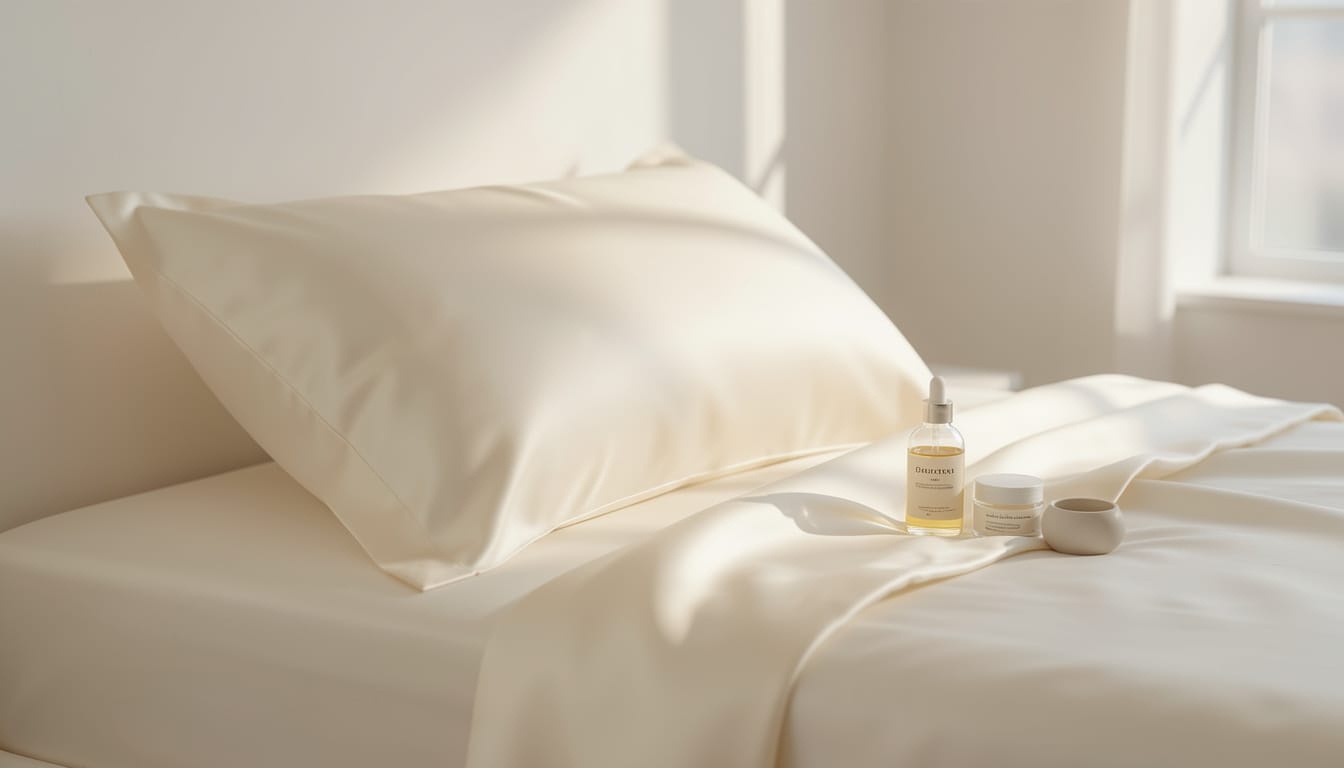
Silk pillowcases and skincare: the friction-reduction evidence explained
Cotton pillowcases create mechanical stress on skin overnight that works against the actives you apply before bed. Here's what the research says about silk, and which pillowcase is worth the investment.
There is a version of this article that leads with a glowing endorsement and a discount code. This is not that article.
The silk pillowcase category is crowded with marketing claims that significantly outrun the evidence. "Prevents wrinkles." "Boosts collagen." "Anti-aging sleep." Most of these claims are either unsupported or conflate correlation with mechanism.
What the evidence actually supports is narrower and more interesting: silk reduces mechanical stress on skin during sleep, and that mechanical stress is a legitimate and underappreciated factor in the breakdown of structural proteins over time. For anyone who has already invested in a serious topical skincare routine — peptide serums, retinoids, active moisturisers — understanding what happens to that routine while you sleep is worth the fifteen minutes this article takes to read.
The mechanical stress problem
Human skin experiences approximately six to eight hours of contact with a pillowcase surface every night. During that time, the face moves — repositioning during sleep cycles, pressing into the pillow, generating friction across the same areas repeatedly.
On a cotton pillowcase, this friction creates what dermatologists call mechanical stress: repeated lateral force applied to the epidermis and upper dermis. The immediate visible effect is sleep lines — the creases that appear on waking and, with age and cumulative exposure, become increasingly difficult to resolve during the day.
The longer-term effect is more structural. Repeated mechanical stress contributes to the degradation of collagen and elastin fibres through two mechanisms. First, direct physical disruption — fibres under repeated lateral tension fracture over time, particularly in areas where the skin is thinnest (around the eyes and mouth). Second, mechanotransduction — the conversion of mechanical signals into biochemical responses. Fibroblasts respond to mechanical stress by upregulating matrix metalloproteinases (MMPs), enzymes that break down extracellular matrix components including collagen. Chronic low-level mechanical stress, repeated nightly, creates a sustained MMP-upregulation environment that accelerates structural degradation.
This is not a theoretical mechanism. The role of mechanical stress in skin ageing has been documented in Skin Pharmacology and Physiology and in facial anatomy research studying sleep position and wrinkle formation. The finding that side-sleepers develop asymmetric facial ageing on the side that contacts the pillow more frequently is one of the cleaner natural experiments in dermatology.
What silk actually does differently
Silk has two relevant properties: surface friction coefficient and moisture interaction.
Friction coefficient
The coefficient of friction of mulberry silk is significantly lower than cotton. Published tribology data places cotton at approximately 0.3–0.4 μ (kinetic friction) against skin, compared to 0.1–0.15 μ for silk. In practical terms, skin slides across silk rather than dragging. The lateral forces that generate sleep lines and contribute to collagen stress are reduced proportionally.
The momme weight of the silk matters here. Momme (mm) is the weight density of silk fabric — a 22–23mm silk has a tighter, more consistent weave that maintains its friction properties over time. Below 19mm, the fibre density is lower and the friction benefits diminish. Fabric marketed as "satin" is not silk — satin is a weave pattern, not a fibre, and is usually polyester. Polyester satin has a low friction coefficient initially but generates static and does not share silk's moisture properties.
Moisture interaction
Cotton is hydrophilic — it absorbs moisture readily. This is useful for towels and problematic for pillowcases, because the moisture cotton absorbs includes the ingredients you apply to your face before bed.
A retinol serum, a peptide moisturiser, or a hyaluronic acid layer applied at night is partly deposited onto a cotton pillowcase rather than remaining in contact with skin. The absorption is not complete — the majority of a product applied to skin stays there — but the portion that transfers to the pillowcase is not trivial, particularly for lighter serums and essences that sit on the skin surface rather than penetrating immediately.
Silk is significantly less absorbent. Its protein structure — fibroin and sericin — does not interact with most skincare actives in the same way. Products applied before bed remain predominantly in contact with skin rather than being drawn into the fabric.
Pros
- +Measurably lower friction coefficient than cotton — the mechanical stress reduction is real and well-documented
- +Lower moisture absorption means topical actives remain in contact with skin rather than transferring to the fabric
- +OEKO-TEX certified options confirm the silk is free from harmful processing chemicals
Cons
- −The direct anti-aging benefit is mechanical and preventive, not regenerative — it reduces further damage, not existing damage
- −Quality varies significantly across brands — momme weight and certification matter
- −Higher care requirements than cotton — most mulberry silk requires cool hand wash or delicate cycle
- −The collagen and moisture benefit claims made by some brands significantly overstate what the friction data supports
Verdict: The evidence supports reduced mechanical stress and better active retention. It does not support claims of direct collagen synthesis or wrinkle reversal. For anyone already spending on quality serums, reducing the friction that works against those actives overnight is a reasonable investment.
Momme weight and what to look for
Momme weight is the single most important specification on a silk pillowcase and is almost never explained in product listings.
19mm and below — lower fibre density, less durable, friction benefits less consistent over time. Acceptable as an entry point but not the standard to buy if you're treating it as a skincare investment.
22–23mm — the standard for premium mulberry silk pillowcases. Tight enough weave to maintain consistent friction properties, durable enough for regular washing, soft enough to provide the tactile experience that makes compliance easy.
25mm and above — heavier, more durable, often used in luxury bedding. Marginally better friction properties than 22–23mm, meaningfully more expensive. The increment over 22–23mm is not significant enough to justify the price difference for most buyers.
OEKO-TEX Standard 100 certification is the meaningful safety certification to look for. It confirms that the silk has been tested for harmful substances at every stage of production — relevant because silk processing can involve chemical treatments that can cause skin sensitisation.
The Promeed Luxgen™ Series
The Promeed Luxgen™ series is positioned specifically for skin and hair care applications. The 100% 3rd-generation mulberry silk designation refers to the silk sourcing — long-strand mulberry silk from Bombyx mori silkworms, which produces a more consistent fibre than wild silk or short-strand alternatives.
The pillowcase is OEKO-TEX certified, which confirms the processing chain meets the safety standard described above. The momme weight sits in the 22–23mm range that the friction data supports.
The product claims map directly onto the evidence: reduced sleep creases from friction reduction, less frizz from lower surface tension against hair, and reduced fine line formation from sustained mechanical stress. The brand does not claim direct collagen synthesis, which is accurate — the benefit is mechanical and preventive.
Promeed 23mm 6A+ Mulberry Silk Pillowcase With Zipper
$40–$70
6A+ grade mulberry silk, OEKO-TEX certified, 23mm. Zippered closure. The friction-reduction and moisture-retention properties are the primary skincare benefit — this is a preventive investment that protects what you're already applying, rather than an active treatment in itself.
- ✓23mm mulberry silk — the specification that matters
- ✓OEKO-TEX Standard 100 certified
- ✓Zippered closure with included laundry bag
How to integrate this into your routine
The friction and moisture-retention benefits of silk require no change to your skincare routine — they work passively once the pillowcase is on the bed.
One timing consideration: if you're applying retinoids, AHAs, or other actives that require absorption time before contact with a surface, give them 15–20 minutes before lying down. This applies regardless of pillowcase material but matters more for powerful actives where you want maximum skin contact time.
Washing frequency matters more on silk than cotton. A silk pillowcase that is washed infrequently accumulates skincare product residue that alters its friction properties. Wash every three to four days — more frequently if you use heavy oils or sleeping masks — on a gentle or delicate cycle with a pH-neutral detergent.
The honest summary
Silk pillowcases are not a skincare treatment. They are a low-friction, low-absorption sleep surface that reduces mechanical stress on skin and keeps your topical actives working as intended rather than transferring to fabric overnight.
For someone spending $80 on a peptide serum and $60 on a retinoid, sleeping on a surface that absorbs a percentage of both every night while simultaneously generating friction against the skin those products are trying to support is a straightforward problem to solve.
The investment is proportionate. The evidence is solid. The claims that go beyond it are marketing.